

Which printing is this? Identify an MTG card by set code and collector number
Read the clues on your card, compare the exact edition, and check language and finish separately. Older cards may not print the codes shown in a catalog.
On this page
THE SHORT ANSWER
Use the set code and collector number, when present, to find possible matches. Then compare the card’s name, set symbol if present, artwork and frame, language, and physical finish. Older cards may lack a printed set code, collector number, or both; those are separate omissions. Leave the identification unresolved when the clues conflict.
Sources below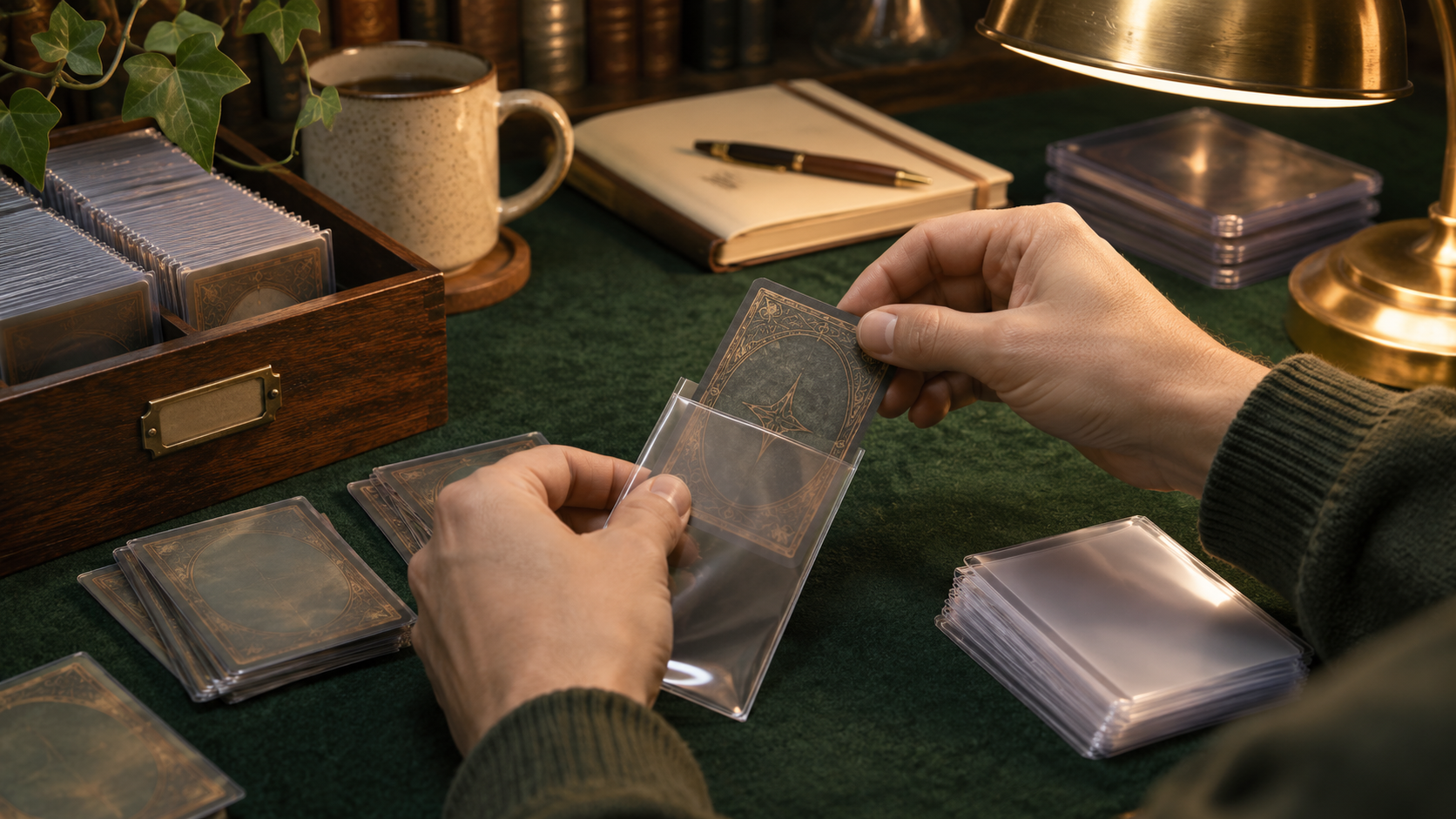
AI-generated editorial illustration.
Image: Cardboard / OpenAI imagegen
- Method
- Compare the physical card with the catalog record
- Examples
- Five records, with older frames and a double-faced card
- Scope
- Identification guidance, not authentication
My card has no set code or number
That does not, by itself, mean anything is wrong with the card. A catalog’s label can contain information that was never printed on the physical copy.
For example, Cardboard identifies Classic Sixth Edition Rowen as 6ED #250. Its card image prints 250/350, but does not have the modern 6ED set-code line. The Visions version is listed as VIS #119, while its card image has no printed collector number. Compare the expansion symbol, border, artwork and copyright line together; a year alone is not enough to identify an edition. [1], [2]
Use the numbered references to find the matching records in Sources & method, then follow the record link.
Five checks before calling it a match
- Read the footer. Look for a set code, collector number and language information. Keep the card number separate from a set total, rarity letter or copyright year. On 250/350, the collector number is 250. [1]
- Search the information you actually have. Try a set code and number together, such as INR #241. If the code is missing, search the card’s name and compare its editions instead of inventing a code from the number alone.
- Compare the visible card. Check the name, artwork, frame and expansion symbol, if present, against the candidate. An expansion symbol is the small set icon; it is different from a written set code. For a double-faced card, compare both faces. [5]
- Check language and finish separately. A collector number does not, on its own, settle either. A scan is useful for artwork and layout, but cannot reliably show the finish of the physical copy in your hand.
- Record the complete match. Save the selected printing’s link and note the language and finish you checked. Keep letters or symbols that belong to the catalog identifier. If an important detail disagrees, retain multiple candidates until you can resolve it.
Five useful comparisons
| Example | What to compare | What it teaches |
|---|---|---|
| Rowen · Classic Sixth Edition #250 [1] | White border, Sixth Edition symbol and printed 250/350 | A card can have a printed number without a modern written set code. |
| Rowen · Visions #119 [2] | Visions symbol, border, artwork and footer | A catalog number need not be printed on the card. |
| Rowen · Seventh Edition #266 [3] | The page’s edition, language and non-foil label | The same card name can have a different number in another set. |
| Rowen · Seventh Edition #266★ [4] | The distinct catalog identifier and foil label, then the physical copy’s finish | Preserve catalog suffixes without assuming every foil uses the same notation. |
| Huntmaster of the Fells // Ravager of the Fells · INR #241 [5] | Both faces, Innistrad Remastered edition, language and finish | Two faces can belong to one physical card; this printing offers both non-foil and foil finishes. |
All five linked catalog records were checked on November 14, 2026. The enlarged Sixth Edition and Visions images were also inspected to compare their physical footer text with the catalog labels. These examples teach an identification method; they do not authenticate an individual copy. [1], [2], [3], [4], [5]
What does the star mean?
Read it in context. Wizards’ Magic 2015 release notes describe a dot or star between the set code and language in that card frame’s collector information. That is different from assuming that a star attached to a catalog number always has the same meaning. [6]
Cardboard’s Seventh Edition Rowen list has separate 266 and 266★ records labeled non-foil and foil. Its Innistrad Remastered Huntmaster #241 record supports both finishes. Use the specific page’s finish information and your physical copy, rather than a universal “star means foil” shortcut. [3], [4], [5]
What if I still cannot tell?
Keep the result unresolved. Missing text, unusual layouts, promos and variants can need more specific reference material. Identification also does not establish authenticity, condition, grading, current stock or a final purchase price. Cardboard’s prices are dated references; check finish, condition, shipping and the seller’s actual listing before buying.
Editorial disclosure: prepared with AI-assisted research and editorial checking.
Sources & method
- Cardboard · Rowen · Classic Sixth Edition #250
- Cardboard · Rowen · Visions #119
- Cardboard · Rowen · Seventh Edition #266 · non-foil
- Cardboard · Rowen · Seventh Edition #266★ · foil
- Cardboard · Huntmaster of the Fells // Ravager of the Fells · INR #241
- Wizards of the Coast · Magic 2015 Core Set Release Notes