

Star Trek chase cards: signed headliners, shock lands and the right variant
The useful distinction is not only which card is valuable, but which printing and finish a price actually describes.
On this page
THE SHORT ANSWER
Signed headliners, surge foil LCARS shock lands and Stardates cards are different collecting categories. Wizards confirms seven genuinely hand-signed headliners, fewer than 250 of each. A displayed asking price for a scarce card is not a verified market sale.
Sources below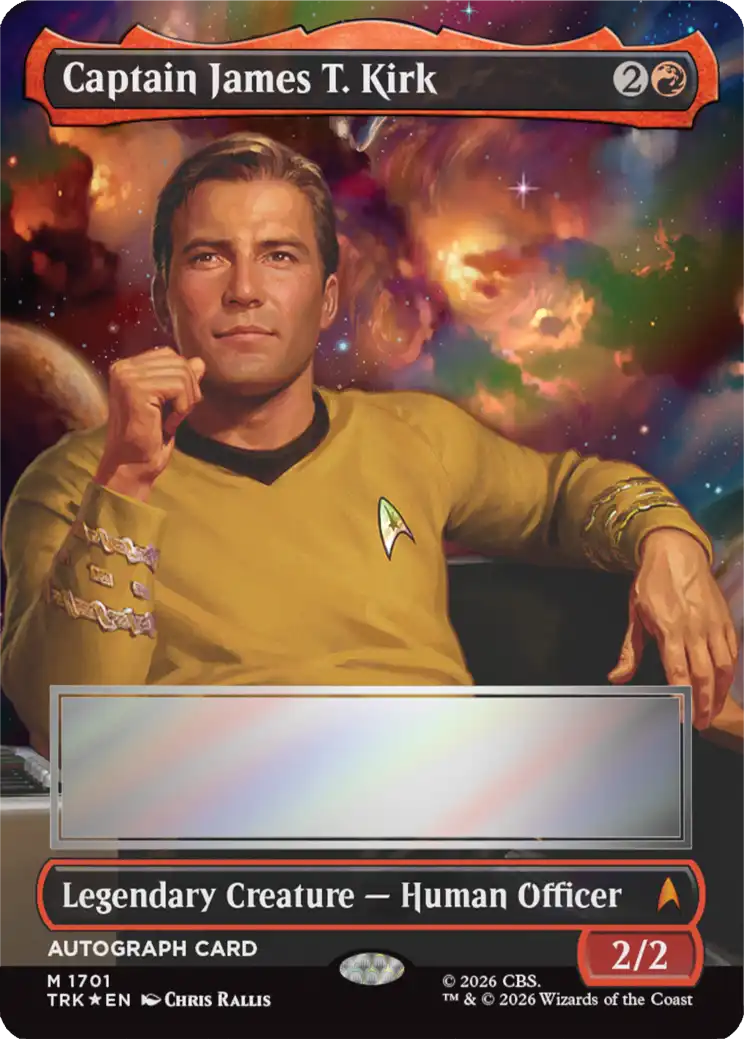
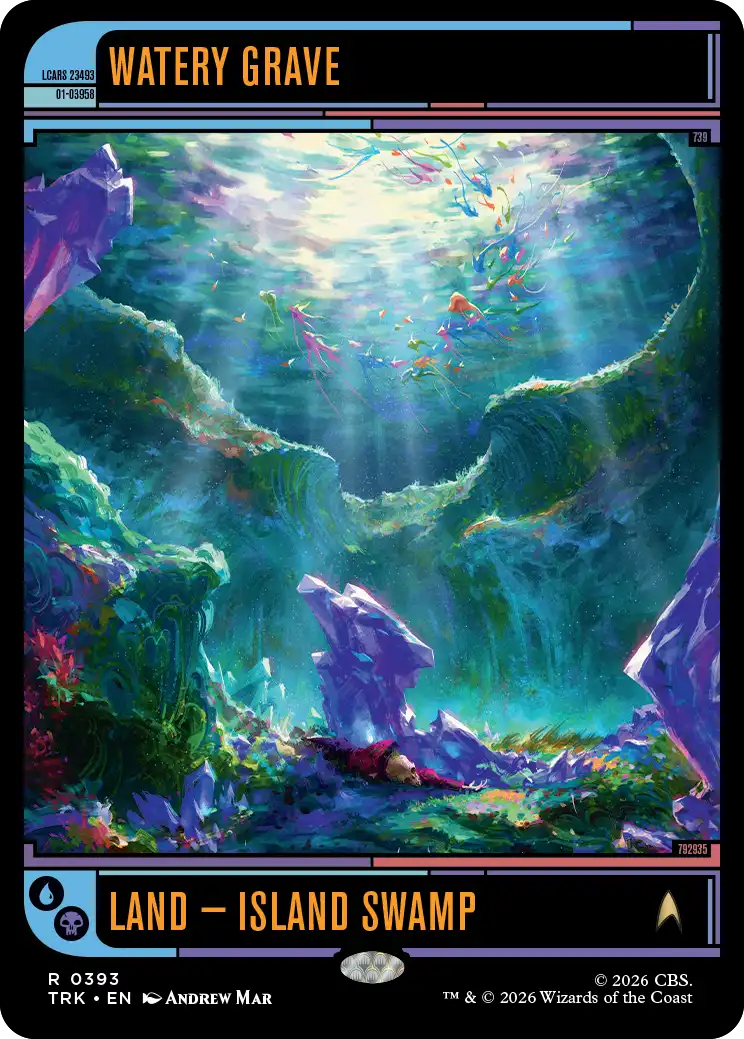
Image: Wizards of the Coast · Original image 1 · Original image 2


- Signed headliners
- seven different cards
- LCARS shock lands
- all ten lands
- Set codes
- TRK / TRC / SDS
Four treatments worth separating
| Treatment | Where it appears | Important distinction |
|---|---|---|
| Hand-signed headliners | Collector Boosters | English cards, even in other-language packs |
| LCARS shock lands | Play + Collector Boosters | Surge foil is Collector-only |
| Stardates · SDS | Play + Collector Boosters | Traditional foil is Collector-only |
| Schematics Spacecraft promos | Beam Me Up Bundle | Two of eight traditional foil promos |
A listing called “foil Star Trek shock land” is incomplete. Ask for the land’s name, set code, collector number and whether it is traditional foil or surge foil. A photograph and the seller’s exact product identifier should agree. [1]
The signatures are physical signatures
Wizards says the seven headliner cards were physically signed by the actors depicted and inserted into Collector Boosters. It states fewer than 250 copies of each signed card and says those cards are always English, regardless of the booster’s language. [1]
That is stronger evidence than a generic “autograph” label, but it does not authenticate a particular secondhand listing. Check the official treatment against the offered card. Do not confuse an unsigned card of the same character with this headliner category.
The official statement is a scarcity description, not a promise that all seven have exactly the same supply. We do not convert “fewer than 250” into an invented exact print run.
A price snapshot that keeps the variant attached
| Exact variant | Captured price point |
|---|---|
| Blood Crypt · LCARS surge foil | $48.70 Market Price |
| Hallowed Fountain · LCARS surge foil | $36.81 Market Price |
| Deep Space 9 · extended art, non-foil | $26.02 Market Price |
| Dr. Beverly Crusher · LCARS surge foil | Market unavailable; listed median $149.99 |
The Crusher row is deliberately not a $149.99 market valuation. Its source displayed no Market Price and a listed median of $149.99. Replacing the missing sale-derived figure with an asking-price statistic would make the table look complete while making it less truthful. [2], [3]
These examples are not an exhaustive list of the most valuable Star Trek cards. Scarce signed cards may lack enough public trade evidence for a defensible price rank.
One name can cross set codes
TRK is the main expansion, TRC is Commander and SDS identifies Stardates. The official guide gives different format contexts for these groups. A thematic Star Trek frame does not itself tell you which set or legality applies. [1]
Some Stardates cards present a familiar Magic card through a Star Trek name and scene. Match the underlying card identity as well as the treatment before comparing listings or adding the card to a deck. Current format legality should be checked separately for the exact card.
A practical buying checklist
- Match card identity, set code and collector number.
- Match the treatment and the actual foil type.
- Separate a market estimate, a recent sale and an unsold asking price.
- Inspect photos, condition and seller terms for the exact copy.
- If you want one card, compare the single with the cost and uncertainty of opening packs.
A chase-card guide should help you identify an object, not persuade you that a random pack is a reliable way to profit.